Between languages and borders: A story of humanizing education
Today, around 1.6 million immigrants live in Portugal, representing approximately 15% of the 10.6 million registered residents in the country. In Lisbon, this diversity takes shape in schools. In the school cluster where I work, there are more than 50 different nationalities; in the primary school where this story takes place, children of 46 nationalities share the same playground, the same hallways, the same classrooms.
It is within this deeply diverse territory that, every morning around 8 a.m., I open the door to a 5th-grade classroom in a public school in Lisbon. A few dozen children walk in, and with them arrive different languages, memories, and entire worlds that do not always fit within the school timetable.
Some enter in groups, laughing, speaking loudly, bringing stories from breakfast or conversations with their parents. Others enter alone, slowly, as if trying to make their bodies keep pace with hearts that beat across different time zones. It is like this almost every morning in my class where two-thirds of the children are migrants or refugees. And it is in this deeply diverse daily life that I learn, every day, that education goes far beyond letters and numbers.
The map of the classroom stretches far beyond its walls
I still vividly remember the first day I saw those faces. It was also the first day I met the Citizenship and Development teacher with whom I would later share a full year of co-teaching. That day, the fragmented classroom dynamics were clear: The desks were arranged in a semicircle. On one side, Portuguese students, Brazilian migrants, and students from other European countries. On the other, migrant students from further East. There were groups of affinity formed mainly by nationality. There were also students who had recently arrived in the country—still shy, insecure, with frightened eyes.
As a Brazilian immigrant myself, I can imagine being in that place. Perhaps it was the fear of not being able to learn in a strange language. Perhaps it was something even deeper. The truth is that the class unfolded amid apparent chaos. Different groups were easily distracted. The teacher made a superhuman effort to capture attention and reach everyone, switching between Portuguese and English, moving constantly around the room, trying to respond to every need. Still, full communication was not possible. Frustration was visible, in the students who experienced the lesson as if trying to decipher encrypted codes, and in the teacher, who, despite her motivation, was close to being overloaded with all she carried.
At the end of the class, I approached her and gently asked how she was feeling. We shared the same fatigue. That was when we began to speak about the importance of prioritizing, above all else, student well-being. Before any other competence, the classroom environment needed to ensure physical and emotional safety. From there, it would be possible to develop empathy, bonds, communication, and language—fundamental competencies for a truly transformative education.
We then proposed integrating the dimension of well-being, in its broadest sense, into the current lesson of sustainable development. And so we did. In the weeks that followed, this sparked a gradual transformation of our classroom.
One day, during a Well-being Circle at the beginning of class, we invited students to write about how they were feeling that morning. Most began immediately. But a boy who had recently arrived from Bangladesh stared at the blank page for a long time. It was not a lack of willingness. Portuguese was still slipping away from him. I sat beside him and typed into the translator app:
“You can write in Bengali.”
He slowly raised his eyes, as if confirming whether that was truly allowed. Then, finally, his hand moved. A few minutes later, he handed me a paper full of words I could not read. I translated and asked if I could share it with the class:
“I am worried about my grandmother. She is sick in my country and could not come with us to Portugal.”
The room fell silent. In that moment, he shared something that went far beyond the exercise: longing, too, is a language.
In the same circle, another student who had recently arrived from Ukraine—who also walked alone through the school—wrote in her own language. With the help of the translator, the message appeared on the screen:
“I miss my cat. I am afraid he will die before I can go back to get him.”
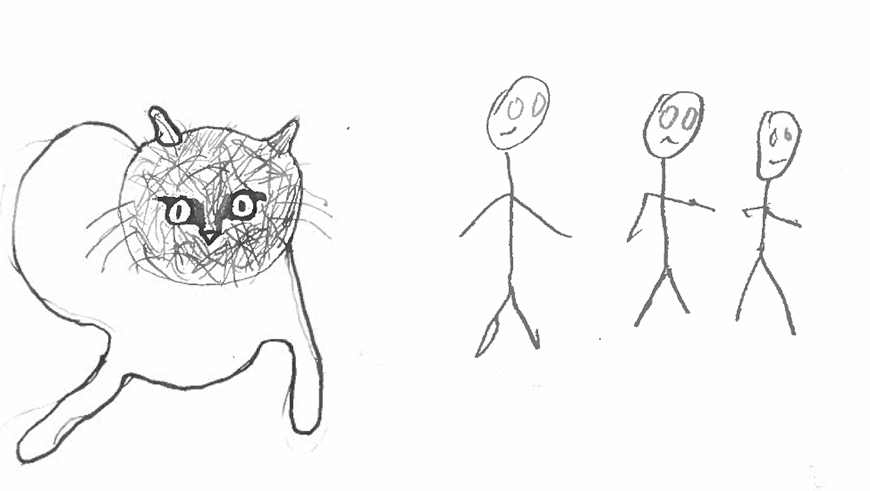
Her classmates’ eyes turned toward her. They wanted to know what the cat was like, whether he could do tricks. She showed them photos. The concern that had once been trapped behind a language barrier became tangible. In the days that followed, they always asked her for news about the animal. Weeks later, we learned that the cat had indeed died. There were tears. Then, there were hugs. And after the tears and the hugs, new friendships were born.
None of these stories emerged by chance. They were cultivated with time, listening, and a kind of patience that sees each child as more than a “student” and each sentence as more than a “task.”
A flower at the center of the classroom
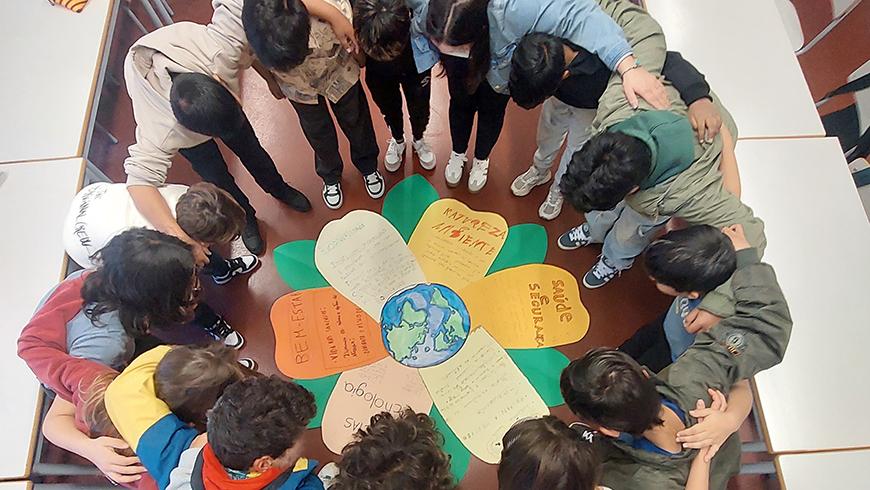
From those conversations, we created a small project about wellbeing. Each group chose a theme they believed could help us take better care of ourselves and one another: friendship, respect, play, listening, nature, movement.
We drew a large flower on a poster. Each petal was illustrated by a group. At the center, we placed a world map showing the countries where the students were born or where part of their family still lives. Each student also made a small personal commitment in favor of individual and collective wellbeing.
It was not just an art activity. It was a map of belonging and collective commitment.
For many children in that classroom, having their hearts stretched between countries is part of their daily life. Some worry about distant grandparents, about siblings left behind, about pets in war zones. Others feel the silent pressure to “adapt quickly” to a language, a culture, and an education system that rarely recognizes how much they have already lived.
In that context, a Well-being Circle, the possibility of writing in different languages, a collective flower on the wall become something greater: small steps toward humanizing education.
Humanizing education in a multilingual and moving classroom
For me, humanizing education is not an abstract ideal. It begins with simple and concrete gestures—allowing a boy to write in Bengali about his sick grandmother, giving time for a Ukrainian girl to express the longing she feels for her pet—as well as understanding that these moments are not distractions from learning, but conditions for it to exist.
Paulo Freire, the renowned Brazilian educator and philosopher, taught us that education is never neutral—it either maintains the world as it is or helps transform it. In a classroom with migrant and refugee students, this means recognizing their rich histories, languages and knowledge as attributes, not deficits. It means recognizing that many live transnational lives, marked by affections, worries, and futures crossed by borders.
This condition is not exclusive to migrant students. Many Portuguese students also live transnational experiences—through the colonial past, family migrations, and the diaspora. Today, about 2.1 million Portuguese people, roughly 20–21% of the total population, live outside Portugal.
That day, the translator app ceased to be just a tool. It became a bridge. The boy began to be seen. The girl began to be heard. The classmates began to feel responsible for one another.
From the Brazilian Indigenous philosopher Ailton Krenak, I learned that the bonds formed through shared care are affective alliances. Over time, these alliances transform the space itself. The classroom ceases to be only desks and a board and becomes a shared collective. When families and the community are brought into this space, the transformation can even expand into the city itself—redrawing places with new stories of belonging.
Redrawing the maps of belonging
When we enter school at 8 a.m., no student carries the same weight.
Some think about recess. Others think about war.
Some worry about grades. Others about visas, borders, and people they love.
Yet they are all there together, trying to learn.
The task of those who educate is not simply to “include” migrant students into a pre-existing model. It is to create bilateral inclusion: a process in which everyone moves, everyone learns, and everyone changes.
It is not about asking children to leave their languages and histories at the door. It is about building a classroom where Bengali, Ukrainian, and Portuguese are all languages of belonging. Where learning Portuguese is strengthened through relationships, not imposed through erasure. Where listening to someone’s longing is also part of the curriculum. Where well-being is a collective project.
Krenak says that perhaps “postponing the end of the world” means “re-enchanting the land we walk on”. In my small classroom in Lisbon, that “land” is made of notebooks, colored pencils, stories, and many passports. To re-enchant it is to turn it into a place where children can live the present and imagine a better future.
The boy who once sat alone now plays football with his classmates.
The girl who cried over her cat now smiles while working in groups.
From the outside, it may not seem like much.
But for them, and for us, it reveals something essential—belonging is not a coincidence; it is a collective and intentional creation.